Infrastructure · Lifts
The double-decker cable car that merged two ski empires
Two enormous, separately owned ski domains, one deep valley between them, and a single cable car with no support pylon that solved the problem in under four minutes. Two decades on, the Vanoise Express is still the cleanest case study in this newspaper's territory of what infrastructure does to a property map.
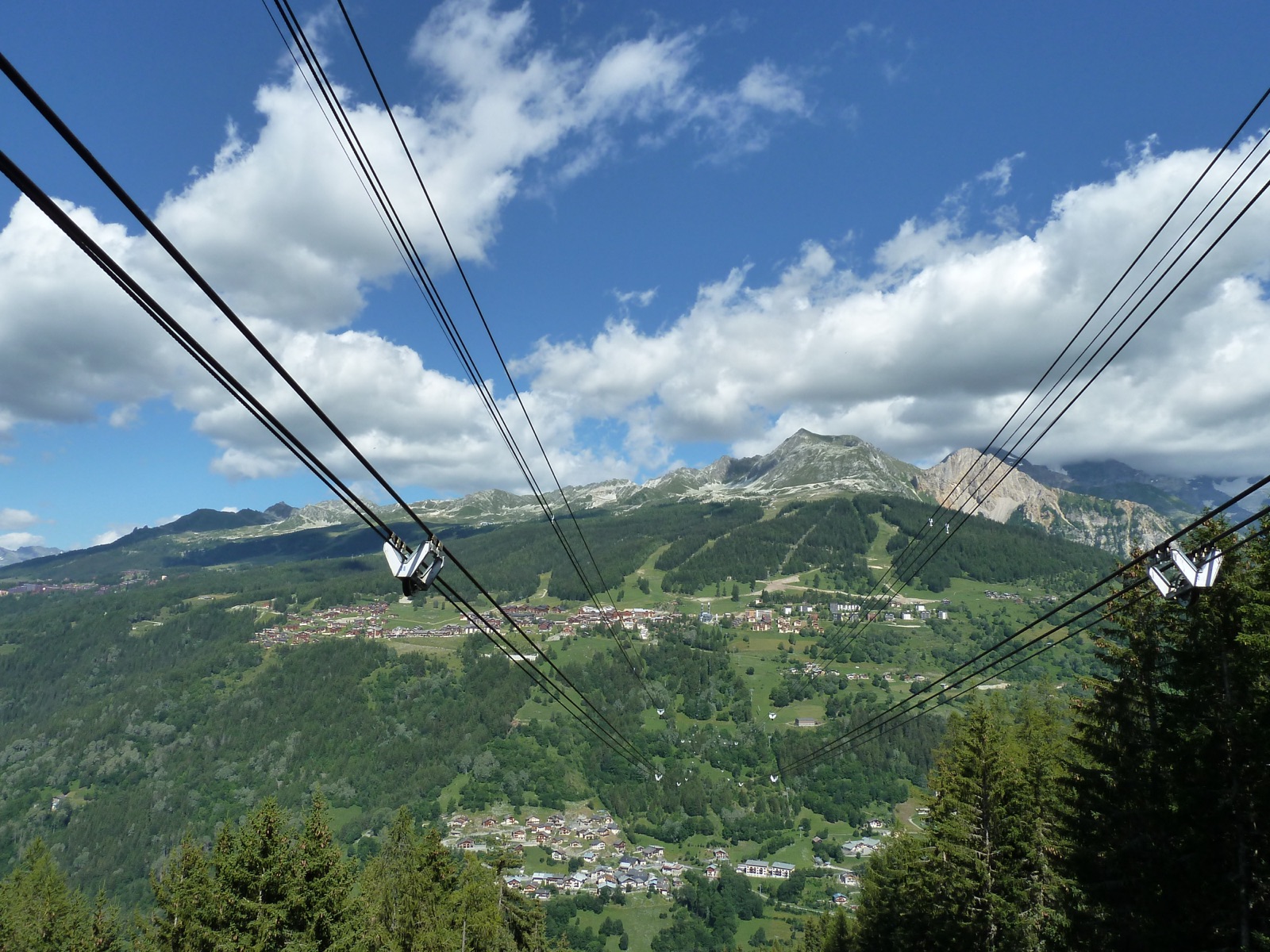
Before December 2003, Les Arcs and La Plagne were, skiably, two different countries. Both enormous — each individually among the largest ski domains in France — separated by the deep, forested Ponthurin valley, they shared a department, a broad region, and almost nothing else on the mountain. A skier based in one could not ski to the other without a lengthy road transfer. The Vanoise Express changed that in under four minutes, and in doing so created Paradiski, a combined domain of over 400km of pistes that instantly ranked among the largest connected ski areas on earth.
The engineering problem, and its solution
The valley between the two domains was too wide and too deep for a conventional multi-pylon cable car to cross economically or, in the operator's judgement, elegantly. The solution — a single unsupported span of roughly 1,850 metres, among the longest of its kind in the world at the time of construction, carried on two masts at either valley edge with no pylon in the intervening forest — let the cable car cross the entire valley in one continuous swoop, at height, in well under four minutes. The cabins themselves were built as double-deckers, doubling passenger capacity per crossing without doubling the cable infrastructure — an engineering choice that has since been widely referenced in the ski-lift industry as a model for exactly this kind of point-to-point domain-linking problem.
| Measure | Detail |
|---|---|
| Opened | December 2003 |
| Span length | ≈ 1,850m, unsupported |
| Crossing time | Under 4 minutes |
| Cabin design | Double-deck, roughly 200 passengers per cabin |
| Combined domain created | Paradiski — 400km+ of linked pistes |
What it did to the two resorts' identities
Before the link, Les Arcs and La Plagne marketed themselves as rivals, in the ordinary way of two large neighbouring domains competing for the same French domestic ski market. The Vanoise Express turned that rivalry into a partnership: Paradiski became a single marketable product, sold jointly, with a combined lift pass and a shared identity that neither resort's individual brand had achieved alone. For property buyers, the practical effect was straightforward and lasting — a lift pass bought in either resort now unlocks both, meaning the choice of which village to buy in became a question of altitude, architecture and price rather than which mountain you would be confined to for the week.
"Before the link, you picked a side and stayed on it for the week. Now nobody thinks about it — you just go where the snow's better that day. It completely changed what people ask for when they're looking at property here."
Estate agent, Bourg-Saint-Maurice — active across both Les Arcs and La Plagne
The property map, two decades on
The most interesting long-run evidence of the link's effect is what it did to the villages nearest the cable car's two stations — Plan Peisey on the Les Arcs side and Montchavin-Les Coches on the La Plagne side — both historically the quieter, cheaper, less fashionable ends of their respective domains, and both now marketed explicitly on their proximity to the Vanoise Express station rather than on their home-resort identity alone. Prices in both have converged upward toward their more famous neighbours' levels over the past two decades, a slower and less dramatic version of the price effect this newspaper documented for the Léman Express in Haute-Savoie — infrastructure that connects two markets tends, over time, to blend their pricing, and the villages closest to the connection point capture the earliest and largest share of that convergence.
What the model suggests elsewhere
The Vanoise Express is, in this newspaper's territory, the clearest completed example of a genre of project still being debated in several other valleys — the domain-linking cable car as a deliberate strategy to create scale that neither resort could achieve alone. It is the model implicitly invoked whenever a mountain mayor proposes a new inter-valley lift, and the twenty-year track record — genuine domain growth, genuine combined marketing power, genuine and lasting property-price convergence in the connected villages — is the strongest argument such proposals have. It is also, worth noting plainly, an argument that requires a specific kind of valley geography and a specific scale of investment that most proposed links do not have readily available. Paradiski worked because the engineering, the two domains' pre-existing scale, and the political will to share a brand all lined up. That combination is rarer than the pitch decks for the next proposed link usually admit.
The technical specification, in more detail
The Vanoise Express is classified as a téléphérique (aerial tramway) rather than a télécabine (gondola), a distinction that matters technically: it operates on a small number of very large cabins on a fixed cable system, rather than a continuously circulating loop of smaller cabins. The unsupported span across the Ponthurin valley was, at construction, among the longest of its type without an intermediate pylon anywhere in the world — an engineering decision driven by the valley's depth and the operator's wish to avoid a costly, environmentally intrusive pylon foundation in protected forest terrain partway down the valley slope. The double-deck cabin design, since referenced and partially replicated in other major lift projects internationally, allowed the installation to move Paradiski's substantial two-way peak traffic (skiers moving between the two domains at the start and end of each day, and around lunchtime) without requiring a second parallel cable system.
The commercial structure behind the link
Les Arcs and La Plagne were, and remain, separately owned and operated ski areas under different délégation de service public arrangements with their respective communes — the same lift-concession structure discussed in our Plan Praz gondola piece. The Vanoise Express required a genuine cross-operator commercial and technical agreement: shared investment in the connecting infrastructure, a jointly marketed combined lift pass (the Paradiski pass), and — the detail that made the whole project politically possible — an agreement that neither operator's existing domain would be commercially disadvantaged by the merger, since skiers gaining access to a rival's terrain could, in principle, have reduced time and spend within their "home" domain. In practice, the combined marketing power of a 400km+ domain proved to grow the overall pie for both operators rather than simply redistributing existing visitors between them, which is broadly recognised within the industry as the key lesson of the project's commercial success.
Villages near the link: the price data
| Village | Side | Position | 20-year price trajectory |
|---|---|---|---|
| Plan Peisey | Les Arcs | Vanoise Express station village | Significant convergence toward Arc 1950/1800 pricing |
| Montchavin-Les Coches | La Plagne | Vanoise Express station village | Significant convergence toward Plagne Centre pricing |
| Arc 2000 / Arc 1950 | Les Arcs | Established high-altitude core | Steady premium growth, link had modest incremental effect |
| Plagne Centre | La Plagne | Established core village | Steady premium growth, link had modest incremental effect |
The pattern that emerges from two decades of transaction data is consistent with what infrastructure economists would predict: the villages that were previously priced as peripheral, lower-tier options within their own domain — precisely because they sat furthest from that domain's original prestige core — captured the largest relative price gains from the link, because they went from being "the quiet edge of Les Arcs" to being "the direct-access gateway to 400km of combined terrain" in the space of a single winter season. The established prestige villages at each domain's historic core saw smaller relative gains, having already been priced near their domain's own ceiling before the link existed.
Related: the broader Tarentaise infrastructure investment cycle, and how the same délégation de service public model funds lift investment elsewhere in the Alps.
[Preview edition — this article is illustrative while Issue No. 1 is in preparation.]
Advertisement
Partner · Property
Domosno
New-build and resale ski property across the French Alps. English-speaking, VAT-reclaim specialists.
View listings