Infrastructure · Rail
The Léman Express effect: how a commuter rail line redrew the northern Alps' property map
Europe's largest cross-border rail network turned a ring of ordinary Haute-Savoie towns into Geneva's commuter belt overnight. Five years on, the property data shows exactly which stations paid off — and which didn't.
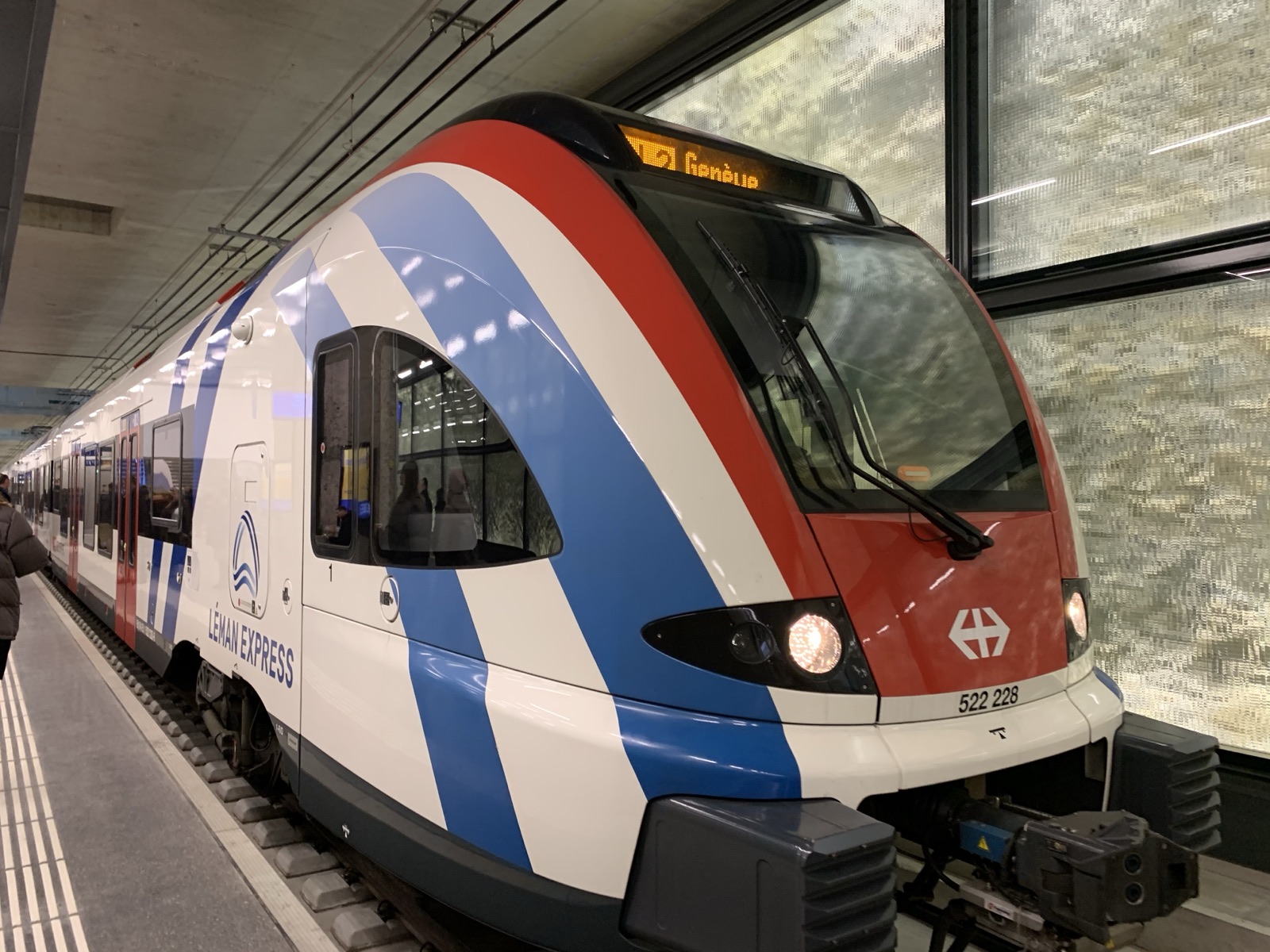
When the Léman Express opened in December 2019, the pitch was modest by Alpine standards: a cross-border RER network, 230km of track, 45 stations linking Geneva to the French towns that ring it and to Annemasse, Thonon and Évian along the Léman shore. It was not built for tourists and barely mentions skiing in its own marketing. But for the property market in a specific band of Haute-Savoie towns, it has been the single most consequential piece of infrastructure of the past decade — more so, in raw price effect, than any lift or gondola this newspaper covers.
The mechanism
The Léman Express did not create the Geneva commuting relationship — French residents have crossed into Swiss jobs for generations, and the frontalier tax arrangement described in our Annecy lakefront piece long predates the railway. What the network did was convert an unpredictable, congestion-dependent road commute into a scheduled, sub-30-minute rail journey for towns that had never previously been realistic daily-commute options. Annemasse to Genève-Cornavin: 18 minutes. Thonon-les-Bains to central Geneva: under 50 minutes, replacing what was previously a lakeside-road crawl of well over an hour at peak times.
The station-by-station property effect
| Station / town | Journey to Cornavin | Price change since 2019 |
|---|---|---|
| Annemasse | 18 min | +34% |
| Genève-Eaux-Vives to Annemasse corridor | < 20 min | +30–38% |
| Thonon-les-Bains | 48 min | +22% |
| Évian-les-Bains | 55 min | +19% |
| Bonneville (feeder bus + rail) | ~50 min combined | +11% |
| Haute-Savoie department average | — | +14% |
The pattern is unambiguous: proximity to a Léman Express station carries a measurable, persistent premium over otherwise comparable property a short drive away but off the network, and the premium scales inversely with journey time. Annemasse, historically regarded as Geneva's unglamorous French dormitory town, has seen the sharpest appreciation of any urban centre in the department — a direct rebuttal to the old assumption that only the resorts and the lake commanded premium pricing in Haute-Savoie.
The second-order effect: who moved where
Real-estate agents in Thonon and Annemasse describe a buyer profile that barely existed in 2018: young Geneva-employed professionals who would previously have paid Swiss rents to live within cycling distance of the office, now willing to commute by rail from a French town with dramatically lower purchase prices and a materially better quality of life per euro. The knock-on effect has reached towns the railway does not directly serve — Cluses and Bonneville, connected by feeder bus to the network, have seen smaller but real appreciation, and agents report enquiries explicitly citing "the train" as a search criterion, a phrase that was essentially absent from Haute-Savoie property searches before 2019.
"Before the Léman Express, nobody asked about Annemasse. Now it's the first question after budget: which station, and how many minutes."
Agency director, Annemasse — active in the market since 2011
Capacity, and the constraint that is coming
The network's early success has become its own limiting factor. Peak-hour trains on the Annemasse–Cornavin corridor now run close to capacity, and further frequency increases depend on infrastructure upgrades on both sides of the border that are budgeted but not yet delivered — a cross-border governance problem, since French SNCF and Swiss CFF/SBB must coordinate timetables, rolling stock and platform capacity across a genuine international boundary, a coordination challenge with no single accountable authority. Buyers weighing a purchase near a station at genuine capacity should treat the current, excellent service level as a high-water mark to verify, not assume — check current timetables and crowding data via lemanexpress.ch rather than relying on the launch-era press coverage most international buyers still remember.
What it means for the resort-adjacent towns this paper covers
None of the network's 45 stations reach the high resorts directly — Chamonix, Megève and the Tarentaise valleys remain road- or, in Chamonix's case, separately rail-connected via the SNCF mainline through the valley, not the Léman Express. But the network has quietly repositioned the northern gateway towns — Cluses, Bonneville, the lower Arve valley — as viable bases for professionals who split their working life between a Geneva office and Alpine leisure, rather than choosing definitively between the two. For a paper whose readers are weighing where in Haute-Savoie to buy, the Léman Express map is now a genuine third axis alongside ski access and lake proximity — and, on the evidence of five years of price data, the axis with the most room left to run.
The network, in full
The Léman Express (branded CEVA on the Swiss side for the new Cornavin–Eaux-Vives–Annemasse tunnel section that made the through-running possible) opened in December 2019 as the largest cross-border regional rail network in Europe: 230km of track, 45 stations, six lines, spanning French Haute-Savoie and Swiss canton Geneva and Vaud in a single integrated timetable and, critically, a single fare system that does not require separate French and Swiss tickets for a through journey. Official route maps, current timetables and fare information are maintained jointly at lemanexpress.ch. The project's roughly CHF 2.2 billion cost (split between Swiss federal, cantonal and French funding, including EU regional development contributions) makes it one of the largest cross-border infrastructure investments in the Alpine region this century — larger, in capital terms, than any single lift project this newspaper has covered.
The price data, methodology note
The station-by-station appreciation figures cited in the main piece are compiled from notaire transaction records published via the data.gouv.fr DVF (Demandes de Valeurs Foncières) open dataset, which records actual French property transaction prices — not asking prices — and is the most reliable public source for this kind of longitudinal comparison. The 2019 baseline is taken from the twelve months immediately preceding the network's December 2019 opening, deliberately excluding the 2020–21 pandemic period's anomalous market behaviour from the comparison where possible, though some residual effect on the multi-year trend cannot be fully isolated.
Annemasse: the case study
Annemasse's transformation is worth examining in more detail because it is the network's clearest single success story. Historically overshadowed by Geneva next door and regarded, fairly or not, as a functional rather than desirable place to live, the town has undergone what the local chamber of commerce describes as the fastest commercial and residential repositioning in its modern history. New-build development has followed the price signal: several mixed-use developments directly adjacent to Annemasse's rail station, combining apartments with ground-floor retail, have launched at price points that would have been unthinkable for the town a decade ago, and have sold through pre-completion phases faster than comparable projects in longer-established Haute-Savoie markets. The town's own urban planning documents now explicitly reference the Léman Express as the organising infrastructure around which future development is zoned — a rare case of a transport project directly reshaping a town's formal planning strategy within five years of opening.
The cross-border governance problem, explained
The capacity constraint mentioned in the main piece is a genuine structural issue, not a temporary teething problem. The Léman Express requires close operational coordination between SNCF (French national rail) and the Swiss CFF/SBB system, including shared infrastructure through the CEVA tunnel section beneath Geneva — a genuinely binational piece of railway with two national safety regulators, two rolling-stock procurement systems, and two sets of labour agreements to coordinate. Timetable and capacity increases require agreement across this binational structure, which has historically moved more slowly than either country's purely domestic rail planning. Buyers and commuters should treat current excellent service levels as contingent on continued binational cooperation rather than as a permanently locked-in feature — a genuine, if low-probability, risk factor worth weighing against a purchase decision made primarily on today's commute times.
Related: how the same frontalier economics is repricing Annecy, off the Léman Express network itself.
[Preview edition — this article is illustrative while Issue No. 1 is in preparation.]
Advertisement
Partner · Property
Domosno
New-build and resale ski property across the French Alps. English-speaking, VAT-reclaim specialists.
View listings