Community · Alpe d'Huez
Alpe d'Huez was the party resort. It is quietly trying to become something else.
Twenty-one hairpins, a Tour de France legend, and a reputation for nightlife that has followed the resort for two generations. Alpe d'Huez's newest investment cycle is betting that reputation can change — and that the dense apartment-block skyline everyone recognises can become an asset rather than an apology.
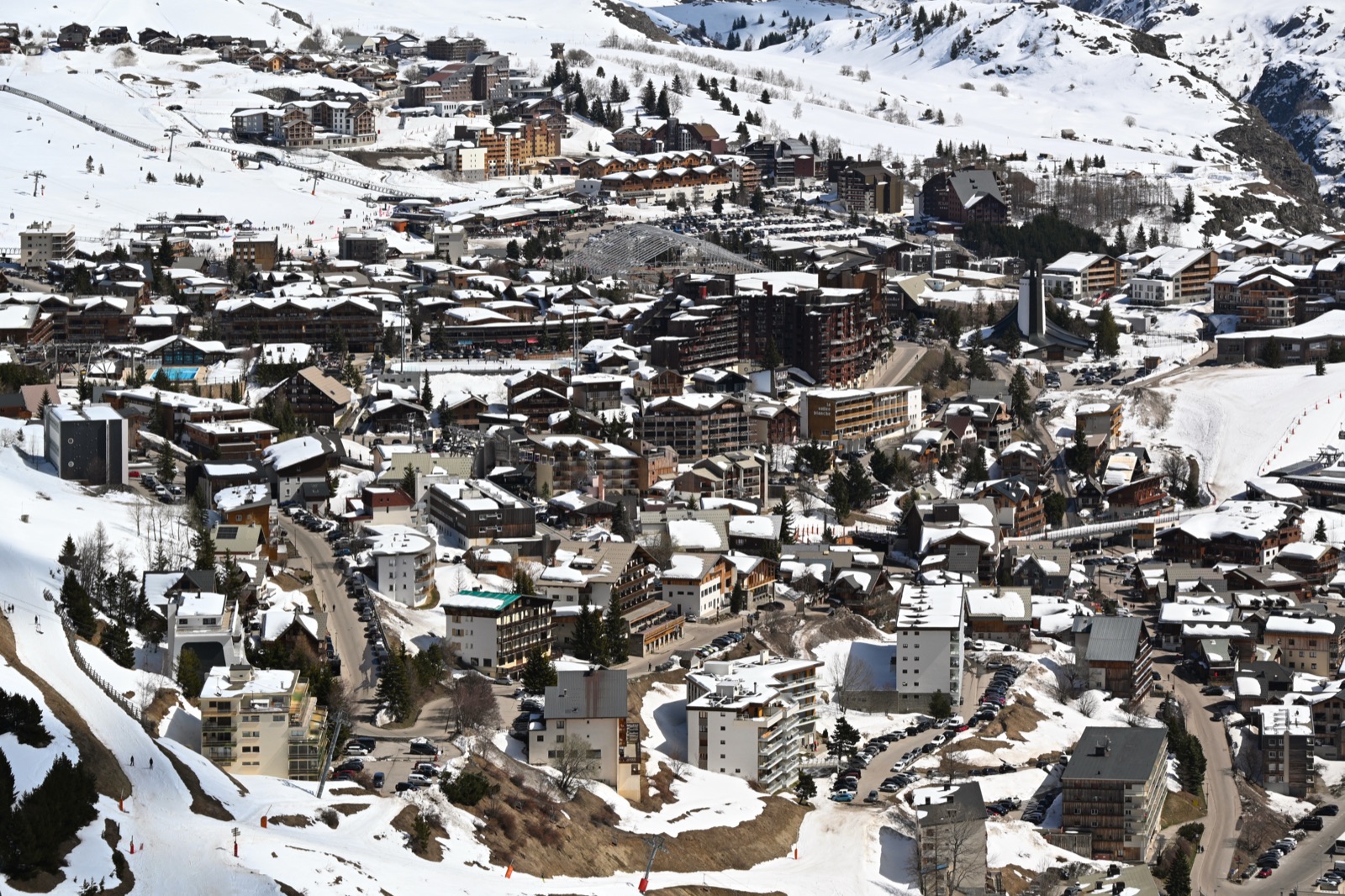
Ask a French skier of a certain generation about Alpe d'Huez and the answer arrives fast and specific: the 21 hairpin bends of the Tour de France's most famous mountain finish, and a nightlife reputation — bars, clubs, a certain amount of studenty chaos in peak season — that has followed the resort since the 1970s and 1980s. It is not an unfair reputation exactly; it reflects a real and long-standing part of what the resort has sold. But it is an increasingly incomplete one, and the resort's own investment priorities over the past decade suggest a deliberate, sustained attempt to build something else alongside it.
The architecture everyone recognises
Alpe d'Huez's built form is instantly identifiable in a way few French resorts are: dense, tall, unapologetically 1960s-and-70s apartment-block construction, built fast during the postwar ski boom to house the maximum number of skiers within walking distance of the lifts. It is the architecture that our ZAN planning piece discussed in the abstract — the compact, land-efficient historic development pattern mountain communes argue should be credited rather than penalised under France's new land-use law — made concrete, literally, in one of its most extreme French examples. For decades this architecture was treated, including by the resort's own marketing, as a slightly embarrassing necessity: efficient, not beautiful, the trade-off you accepted for ski-in convenience.
What the newer investment is doing
| Strategy | What it looks like on the ground |
|---|---|
| Facade and public-realm renovation | Systematic re-cladding and balcony renewal on older blocks, pedestrianised centre improvements |
| Family & wellness positioning | Expanded childcare and ski-school infrastructure, spa and aquatic-centre investment |
| Summer diversification | Via ferrata, trail running, the resort's own altitude golf and mountain-bike offer |
| Renovation-led new stock | Older résidences stripped and rebuilt to current thermal and design standards on the same footprint |
None of this is a demolition of the old identity — the nightlife has not gone away, and the resort has no interest in pretending it has. It is, more precisely, an attempt to build a second identity alongside the first one, aimed at a family and wellness-oriented buyer who might otherwise have ruled the resort out on reputation alone without ever checking whether the reputation matched the whole picture. The renovation-led approach to new stock — discussed in the abstract in our ZAN piece — is a particularly good fit for Alpe d'Huez specifically, since so much of its existing building stock is now old enough to need a genuine structural refresh rather than cosmetic patching, and land-constrained enough that rebuilding on the same footprint is the practical path regardless of planning policy.
"We're not trying to become Megève. We know exactly what we are and what brought people here for fifty years. What we're trying to do is make sure the family looking at us for the first time doesn't rule us out based on a reputation from before they were born."
Resort development representative, Alpe d'Huez
Whether it is working
The honest answer, on the evidence available, is partially. Alpe d'Huez's skier profile has genuinely broadened over the past decade — family bookings and childcare-dependent stays have grown as a share of the resort's business, agents report, and the renovated stock commands a real, measurable premium over unrenovated apartments in the same buildings. What has moved more slowly is the resort's image among the specific international, property-buying audience this newspaper writes for, many of whom still carry the older reputation as their entire mental model of the place, unrevised since a university ski trip decades earlier. That gap — between what the resort has actually become and what a specific generation of potential buyers still assumes it is — is, in miniature, exactly the kind of story this newspaper exists to correct. Alpe d'Huez is not for every buyer. But the version of it that exists today is a materially different proposition from the one its reputation still describes, and the price gap between it and its more consistently marketed neighbours reflects the lag in that story reaching the people who might act on it.
The Tour de France identity, and its double edge
Alpe d'Huez's 21 hairpin bends are arguably the single most famous stretch of road in professional cycling, each corner named for a stage winner and mobbed by cycling tourists year-round, not just during Tour de France years the race includes the climb. This identity has been an unambiguous commercial asset — a genuine, globally recognised piece of sporting heritage that draws a cycling-tourism trade independent of skiing entirely, filling shoulder-season weeks that would otherwise sit empty. But it has also, resort marketers privately concede, reinforced a narrower image of the resort as a destination for a specific kind of athletic, party-oriented, predominantly younger visitor — an image that sits awkwardly alongside the family and wellness positioning the newer investment cycle is trying to build in parallel.
The apartment-block stock, and what renovation actually involves
| Era of construction | Typical characteristics | Renovation approach |
|---|---|---|
| 1960s first wave | Dense, functional, minimal insulation, small units | Often demolition and rebuild on same footprint |
| 1970s–80s expansion | Larger units, some architectural ambition, still poor thermal standards | Facade renovation, internal reconfiguration, thermal upgrade |
| 2000s–10s selective infill | Better standards, higher-spec finishes | Light refresh, largely already competitive |
| Current cycle | Full renovation-led, target higher DPE bands | Complete strip-and-rebuild, matching France-wide DPE pressure |
The DPE (diagnostic de performance énergétique) pressure discussed at length in our Val d'Isère buying guide applies with particular force to Alpe d'Huez's older stock, much of which was built to thermal standards that predate any meaningful French energy-efficiency regulation. Buyers evaluating an unrenovated 1960s or 1970s apartment should treat the DPE rating as a central negotiating point, not a formality — a poor rating in this specific resort's stock is common rather than exceptional, and the gap between renovated and unrenovated pricing within the same building has widened measurably as the regulatory and buyer-preference pressure has increased.
The summer diversification, assessed honestly
Alpe d'Huez's summer offer — via ferrata routes, an expanding mountain-bike network, an altitude golf course, and the general trail-running infrastructure now standard across ambitious Alpine resorts — is genuine and growing, but it remains, on the honest assessment of agents active in the resort, less developed and less internationally known than the equivalent summer offers built by Chamonix or Les Deux Alpes, discussed elsewhere in this newspaper's coverage. This is less a criticism of Alpe d'Huez's effort than a reflection of a later start: the resort's summer-diversification investment cycle began meaningfully later than in some northern rivals, and the international marketing recognition that follows genuine summer infrastructure takes years to build regardless of the quality of what has actually been constructed.
Related: a neighbouring Isère resort's own summer identity, built around its glacier, and the wider Alpes du Sud market this resort sits within.
[Preview edition — this article is illustrative while Issue No. 1 is in preparation.]
Advertisement
Partner · Property
Domosno
New-build and resale ski property across the French Alps. English-speaking, VAT-reclaim specialists.
View listings