Community · Chamonix
The families who have guided Mont Blanc for six generations
In a valley increasingly defined by who can afford to buy into it, a handful of families have held a different kind of position for two centuries: the ones who take you up the mountain and, more importantly, bring you back down. Their trade is now being reshaped by the same forces reshaping everything else in Chamonix.
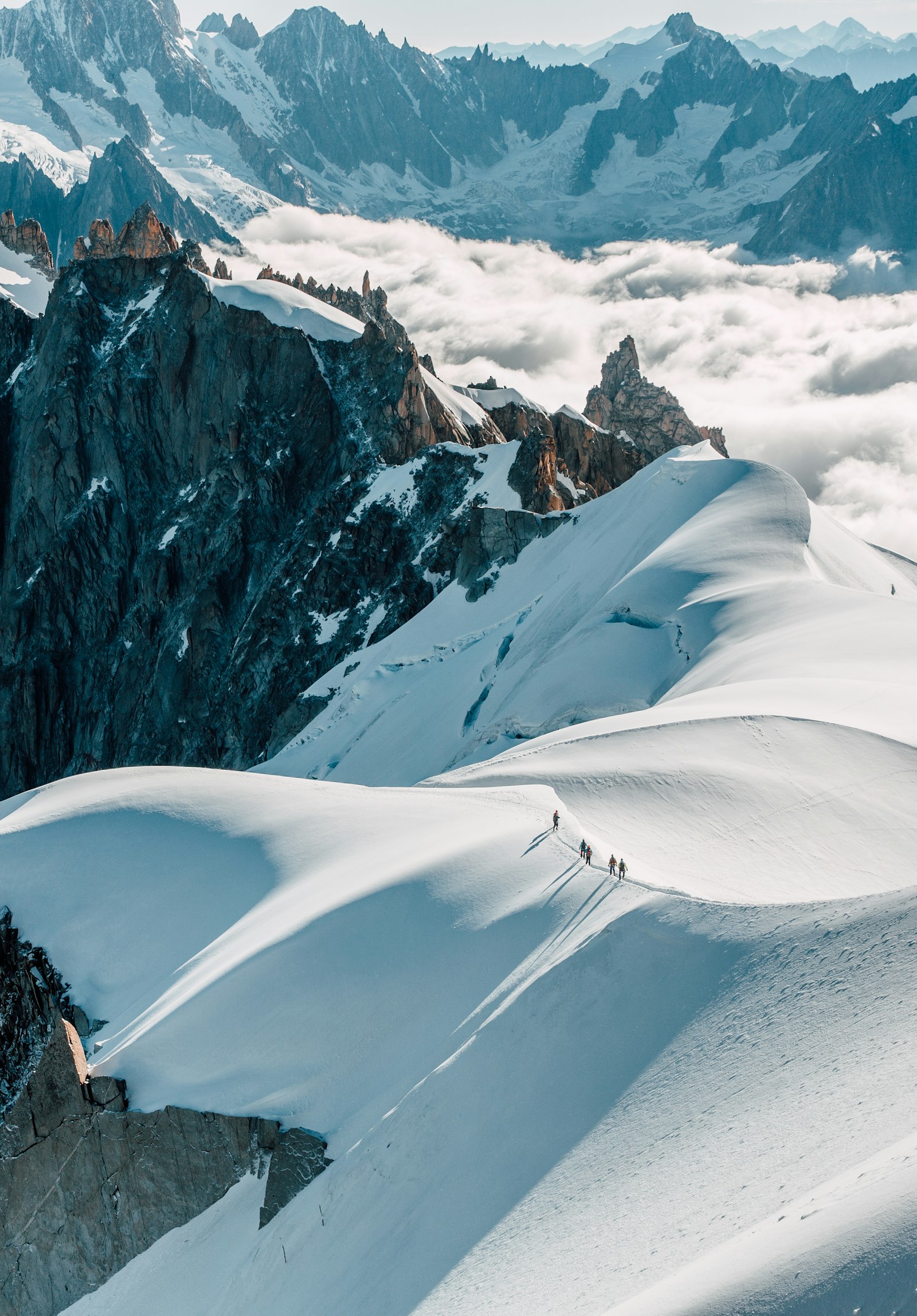
The Compagnie des Guides de Chamonix, founded in 1821, is widely regarded as the world's oldest mountain guiding company, formed in the aftermath of a rescue disaster on Mont Blanc that convinced the valley's climbing porters they needed formal structure, shared risk, and a system that did not leave the most skilled and the most reckless competing for the same clients. Two centuries on, the Compagnie is still a working guides' co-operative, not a heritage brand, and a striking number of its current members carry surnames that appear in its earliest membership rolls — Charlet, Devouassoud, Payot, Ravanel, Simond among them. Several families count six or more consecutive generations of qualified guides, a lineage that is, in professional terms, almost unheard of anywhere else in the world.
How the trade actually passes down
Nothing about becoming a Chamonix guide is inherited in the formal sense — the qualification (the diplôme d'État of guide de haute montagne) is one of the most demanding professional certifications in France, requiring years of climbing experience before candidature and a multi-year training and examination process afterward, open to anyone who qualifies regardless of surname. What the guiding families transmit is not the credential but the apprenticeship: a childhood spent on the terrain before most peers have learned to ski parallel, an intimacy with specific routes and their moods across different seasons and snow years that no training course can fully replicate, and — guides themselves consistently cite this — the psychological education of watching a parent make the hundreds of small, undramatic risk decisions that keep a client alive, absorbed as ordinary family conversation rather than formal instruction.
"My father didn't teach me to guide. I just grew up watching him decide, every single day, whether today was a day to go up or a day to say no. That decision is the entire job. Everything else is technique."
Fourth-generation Chamonix guide
What has changed about the job
| Era | Typical client | Typical season |
|---|---|---|
| 19th century | Wealthy British and European alpinists, first ascents | Short summer window |
| Mid-20th century | Serious climbers, growing ski touring | Summer alpinism + emerging winter guiding |
| Today | Broader mix: corporate groups, family ski weeks, ultra-runners, off-piste clients | Near year-round, but income concentrated in fewer peak weeks |
The guiding trade's economics have shifted in ways that mirror the rest of the valley's tourism economy: a broader, more diverse client base, but income increasingly concentrated into the same high-value peak periods — February, the UTMB week discussed in our trail-running piece, the settled-weather windows of a good August — that define every other trade in this newspaper's territory. Off-piste and ski-touring guiding, barely a formal category a generation ago, is now, several guides report, a larger share of winter income than classic mountaineering, a shift driven by the same growth in confident, well-equipped intermediate skiers that has reshaped the resort's own off-piste risk profile.
The housing question, again
Even the guiding dynasties are not exempt from the pressure documented throughout this newspaper's coverage of Chamonix housing. A guide's income, while respectable, is seasonal and typically self-employed — precisely the profile that struggles most in a mortgage and rental market increasingly priced for salaried Geneva professionals and international second-home buyers, discussed in our seasonnaire housing piece. Several long-established guiding families report that younger members, despite the professional inheritance and local roots, have had to move to Sallanches, Cluses or further down the valley to afford a family home — commuting back into Chamonix for work in a valley their surname has worked for two hundred years. It is a quieter, more specific version of the housing story than the seasonal-worker crisis, but it points at the same underlying mechanism: local roots and professional value no longer translate reliably into the ability to live where you work.
Why the dynasties matter to a newspaper about property
It would be easy to treat the guide families as heritage colour, unconnected to the property market this paper mostly covers. The connection is more direct than it looks. The Compagnie des Guides' continued existence, staffed substantially by people who grew up on the exact terrain they now guide clients across, is part of what makes Chamonix's mountain experience genuinely different from a resort with equivalent lift infrastructure but no comparable guiding culture — it is, in the driest possible commercial terms, a component of the valley's brand value, the kind of intangible asset that shows up in property premiums without ever appearing on a spec sheet. A valley that guides itself out of business by pricing out the people who have always known its mountains best is not merely losing a picturesque tradition. It is quietly eroding one of the things that makes the property worth what it currently costs.
The Compagnie des Guides, structurally explained
The Compagnie des Guides de Chamonix operates as a genuine professional co-operative, not a single employer — individual guides are self-employed members who share the Compagnie's brand, booking infrastructure, insurance framework and, historically, an informal system for distributing client demand fairly among members regardless of individual reputation, an egalitarian structure unusual in a profession where star power could easily dominate. The organisation's own history and current membership structure are documented at chamonix-guides.com. The formal qualification all members hold, the diplôme d'État accompagnateur en moyenne montagne or, for the highest mountain terrain, guide de haute montagne, is awarded through France's national mountain sports training system administered by the École Nationale de Ski et d'Alpinisme (ENSA) in Chamonix itself — meaning the town that most needs elite guides also trains a significant share of France's national supply, a virtuous concentration of expertise found in few other places.
The historical roll, and what it reveals
The Compagnie's founding in 1821 followed a specific, well-documented tragedy: the deaths of several guides and a client on Mont Blanc's Rochers Rouges in 1820, an event that convinced Chamonix's climbing guides — until then operating informally and often in direct competition for clients — that formal structure, shared safety standards and a system for spreading both risk and reward would serve the trade better than unregulated competition. The founding membership rolls, preserved in the Compagnie's own archive and referenced in several published histories of Chamonix mountaineering, already contained several of the surnames — Balmat (Jacques Balmat having made the first documented ascent of Mont Blanc in 1786, just decades before the Compagnie's founding), Devouassoud, Payot — that persist among today's membership. The continuity is genuinely unusual: few professions anywhere maintain a two-century, geographically fixed, surname-traceable lineage in a formally regulated modern qualification system.
The economics of a modern guiding career
| Income source | Typical share of annual income | Trend |
|---|---|---|
| Winter ski touring & off-piste guiding | 35–45% | Growing |
| Summer alpinism & classic routes | 20–30% | Stable to declining |
| Corporate & group guiding | 10–15% | Growing |
| Via ferrata & family/intro terrain | 10–15% | Growing rapidly |
| UTMB week & event-adjacent work | 5–10% | New, growing |
The shift toward off-piste and ski-touring guiding as the dominant income category reflects both a genuine growth in demand — a larger population of well-equipped, moderately experienced skiers wanting professional terrain judgement rather than technical instruction — and a broader industry trend toward shorter, more frequently repeated bookings (a half-day or single-day off-piste outing) replacing the longer, rarer classic multi-day alpinism booking that dominated the trade a generation ago. Guides describe this as a more financially stable but professionally less romantic version of the job: more days worked, shorter and more repetitive engagements, less of the sustained multi-day client relationship that defined classic guiding.
The housing data, specifically for self-employed mountain professionals
Chamonix's own housing affordability data, discussed at greater length in our seasonnaire housing piece, is particularly unfavourable to self-employed guides because French mortgage lending, discussed in our mortgage guide, weighs self-employed income more conservatively than salaried income — typically requiring a three-year average of tax-declared earnings rather than crediting a single strong season, which penalises a profession whose income is inherently variable year to year with snow conditions and client demand. Several younger guides interviewed for this piece described being offered materially lower mortgage amounts than salaried Geneva-commuter neighbours with comparable gross annual income, purely as a function of the self-employed income assessment methodology — a structural, largely invisible disadvantage layered on top of the general Chamonix affordability crisis.
[Preview edition — this article is illustrative while Issue No. 1 is in preparation.]
Advertisement
Partner · Property
Domosno
New-build and resale ski property across the French Alps. English-speaking, VAT-reclaim specialists.
View listings